
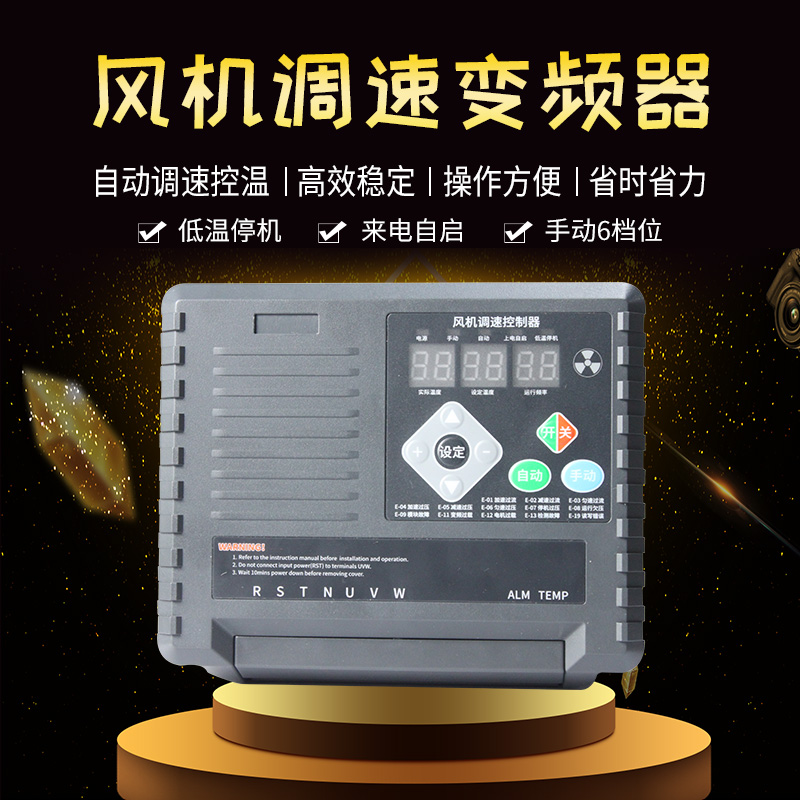
Livestock fan VFD: three-phase 380 V, 3 kW, PID air-volume control, actual temperature, set temperature and running frequency on one display, six manual steps, low-temperature stop and auto-restart, fault codes shown directly on screen.
| Supply | Three-phase 380 V (R S T N in, U V W out) |
|---|---|
| Power | 3 kW |
| Control | PID automatic speed and temperature control |
| Display | Actual temp, set temp, running frequency |
| Manual | 6 steps, low-temp stop, auto-restart |
| Taobao | https://item.taobao.com/item.htm?id=638330137549 |
A grey sheet-steel case, angled cooling slots down both sides, a control panel on the front and a row of terminals along the bottom. The panel reads "fan speed controller": three-phase 380 V in, three-phase out to the fan, with speed changed by changing the frequency in between.
Three figures side by side — that is the thoughtful part
The display is split into three windows, labelled actual temperature, set temperature, running frequency.
Spread across three places is the usual state of a house: the thermometer on the wall, the setpoint in someone's head, and nobody knowing how fast the fan is turning. Side by side it reads at a glance — how warm it is, what it is meant to be, and what frequency the fan is running. That earns its keep on a service call: when someone rings to say "the house will not cool down", these three numbers separate a genuinely hot house from a setpoint that was changed from a fan that never started.
PID is not mysterious: big gap, run fast; small gap, run slow
A fixed-speed fan knows two instructions: start at temperature, stop at temperature. The curve that produces is a sawtooth — overshoot, pull back, overshoot again — and the animals live inside that swing.
PID control of air volume changes the question. It does not decide "run or stop", it decides "how fast": a wide gap to setpoint pushes the frequency up, a narrow gap lets it fall back, and near setpoint the airflow simply holds the house where it is. The temperature is not knocked back onto the line, it is carried on it. The difference shows in the shoulder seasons, when day and night differ by a dozen degrees: a fixed-speed fan switches on and off all night, a PID unit climbs slowly through it.
Five lamps, five facts
Along the top: power, manual, auto, auto-restart on power-up, low-temperature stop.
Those five names are the whole operating model. Manual and auto are modes, one of the two is always lit, so it cannot be misread. Auto-restart lit means that after an outage the unit picks up where it left off instead of waiting for someone to walk over and press a button. Low-temperature stop lit means a winter floor has been set, and below it the fan stops rather than pulling more cold air in. One look at the cabinet, no menu.
Six manual steps, for the days a person decides
However well the automatic mode runs, some days need a human setting. Cleaning out, washing down, ventilating an empty house before stock arrives, checking a replacement fan turns the right way — those want a fixed airflow, not a target that moves on its own.
Press manual and pick one of six steps. The steps are six fixed numbers, not a guess somewhere between 0 and 100: if step three suited the last house, step three suits the next one, and two different people get the same result. That is what "easy to operate" on the poster means — one set key, four arrows, plus, minus, on/off, auto, manual: nine keys and the job is done, no parameter table to memorise.
When it trips, the display gives a code
A fault-code table is printed on the panel: E-01 overcurrent on acceleration, E-02 overcurrent on deceleration, E-03 overcurrent at constant speed, and so on down the list.
The point is that a tripped fan does not leave you with the word "fault" and nothing else. It says overcurrent, overvoltage, lost phase or overheat. Reading a code down the phone is faster than describing symptoms, and the person at the other end can tell whether the problem is the load, the wiring or the supply. Two more lamps sit on the right, ALM and TEMP, which separate an electrical trip from a temperature-triggered one.
Wiring and sizing at 3 kW
Terminals left to right: R S T N are the incoming supply, U V W go out to the fan motor. Three warnings are printed on the case and the second deserves its own sentence: never land the incoming supply on U V W. Getting that wrong destroys the drive the moment power is applied, and it is the one mistake on site that cannot be undone. The third warns you to wait ten minutes after isolating before removing the cover — the DC bus capacitors do not empty when the breaker drops.
At 3 kW, three things settle the selection: the fan's rated power on its nameplate (it must not exceed this unit's ceiling), whether the motor is three-phase 380 V (single-phase fans do not apply), and belt-driven or direct-drive (direct drive asks more starting torque). Give us those three and the configuration is right first time.
Phone: +86 199 3789 6911.
Popular products
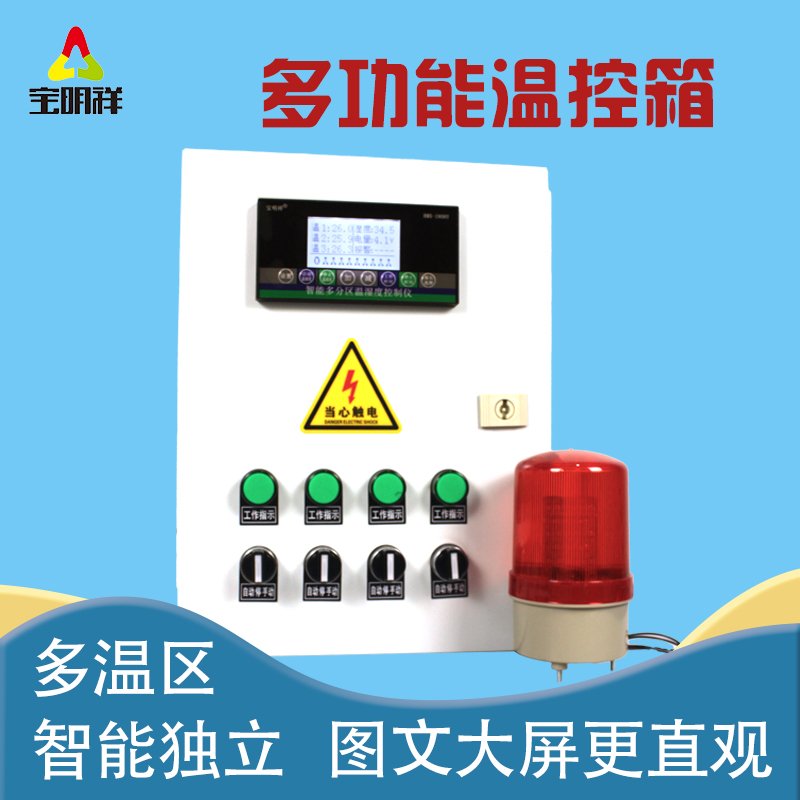 Livestock temperature control cabinets
Multi-function temperature and humidity cabinet: multi-zone display, power-failure and high/low alarms
Baomingxiang multi-function cabinet: a graphic LCD listing temperature and humidity zone by zone, an internal battery so display and alarm survive a mains failure, four run lights with Auto/Off/Manual selectors, and a red sound-and-light beacon for over-temperature, under-temperature and power loss.
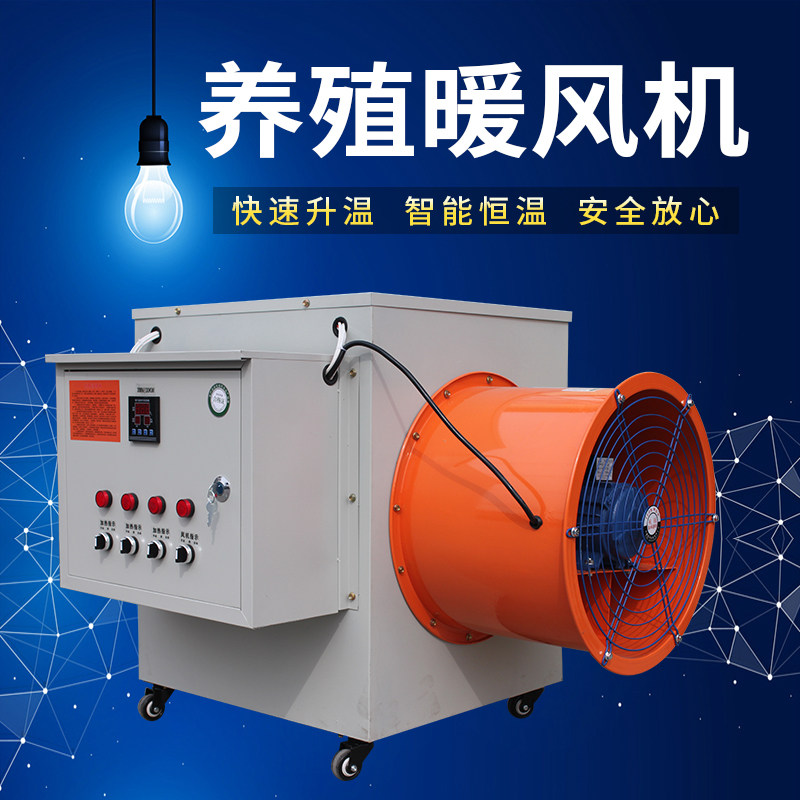 养殖暖风机
Livestock temperature control cabinets
养殖暖风机 电加热恒温热风机:快速升温 · 智能恒温 · 畜牧养殖/烘干/车间取暖
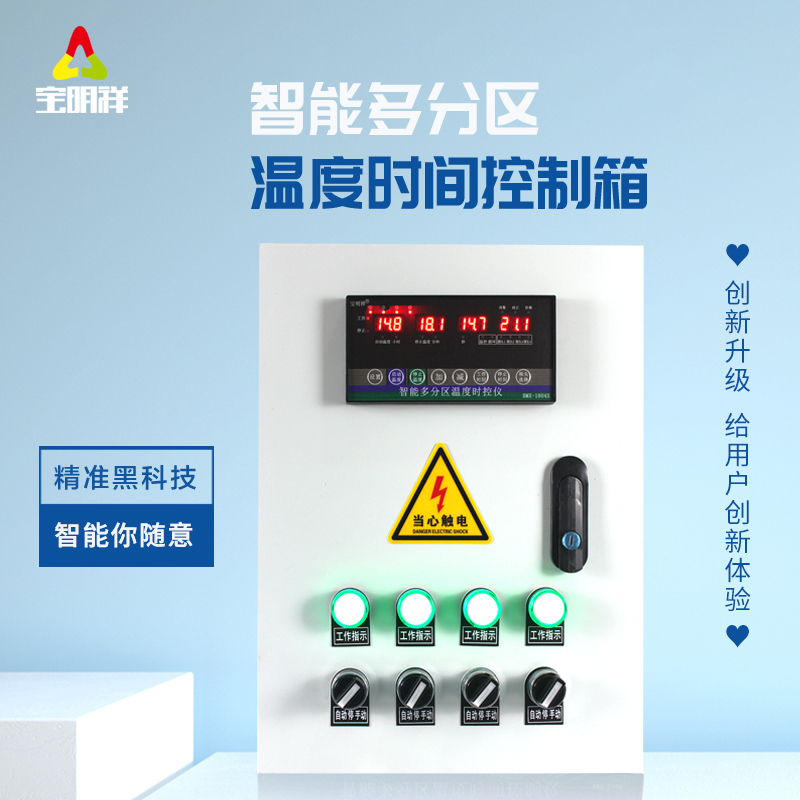 Livestock temperature control cabinets
Digital multi-zone temperature and time controller cabinet for farm fans and cooling pads
Baomingxiang BMX-1804X multi-zone temperature and time cabinet: four seven-segment displays for four zones, temperature control alongside clock-based timing, four run lights and four Auto/Off/Manual selectors, built for farm fans and cooling pads.
 Environmental controllers
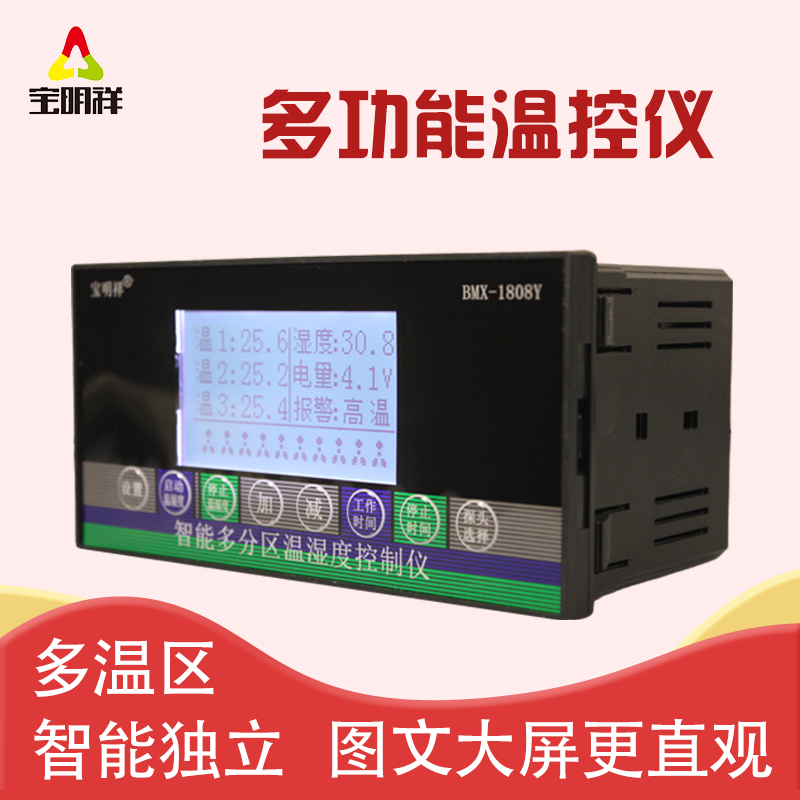
Livestock temperature and humidity meter BMX-1808Y: zoned display, power-failure alarm
Baomingxiang BMX-1808Y multi-function meter: a graphic LCD listing temperature with humidity, battery voltage or alarm state zone by zone, an internal battery so display and alarm survive a mains failure, and eight keys for start/stop temperature and periods. Panel-cut-out mounting for new or existing cabinets.