
Positive and negative pressure with precise variable-speed ventilation, in Liaoning
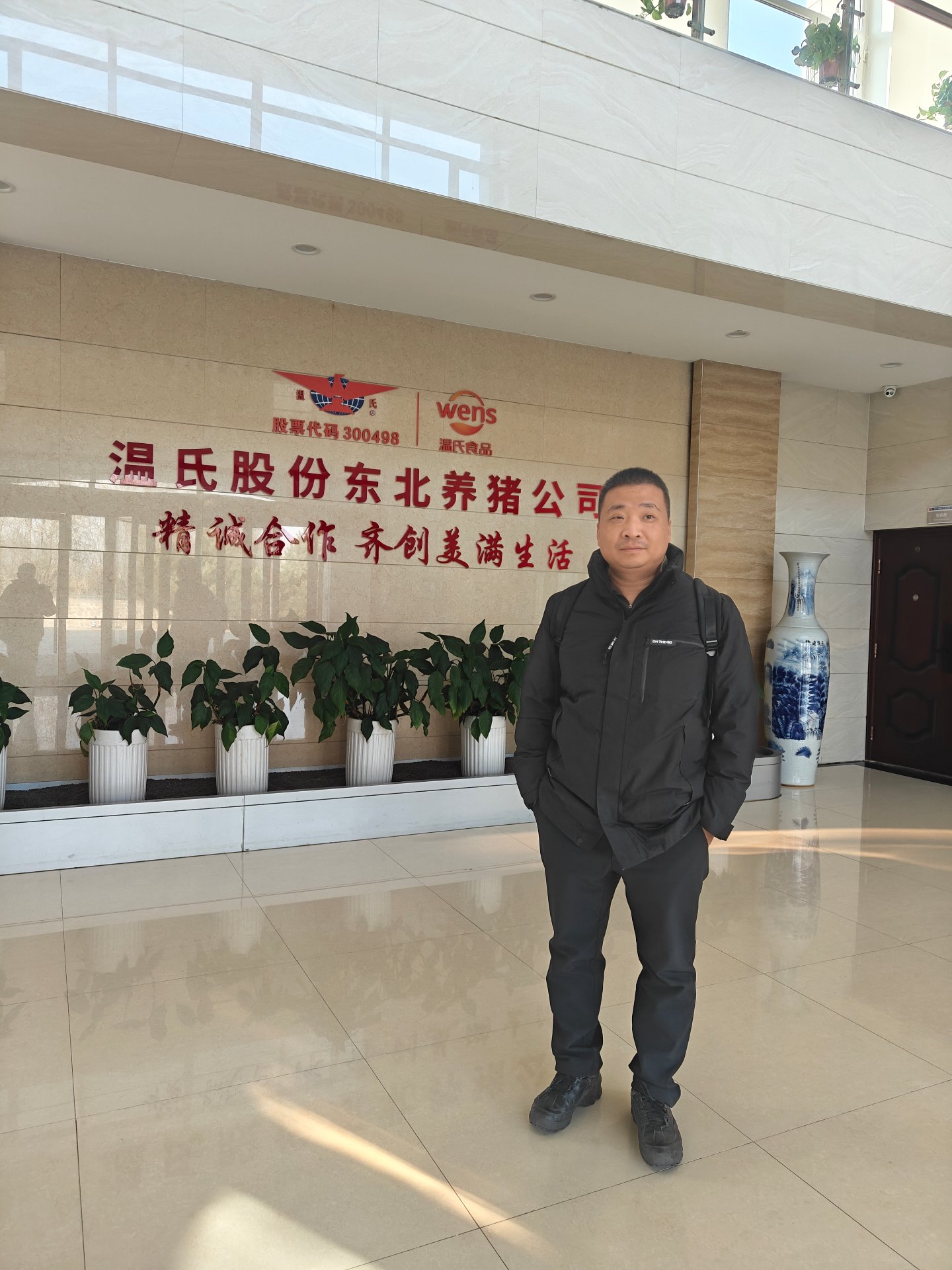
Baomingxiang's technical team travelled to Liaoning for on-site service on the pig houses of Wens Northeast Pig Company: positive-pressure filtration and negative-pressure exhaust scheduled by stage, staged fan speeds against house temperature, parameters set after checking the houses, fans and probes.
Liaoning: Wens Northeast Pig Company
This trip to Liaoning was on-site service for positive- and negative-pressure ventilation with precise speed control in the pig houses of Wens Northeast Pig Company. A colleague stopped for a photo in the lobby — the line on the wall, "sincere cooperation, a better life together", reads much like what we were there to do.
Ventilation in northeast China has to handle both ends at once: cold in winter, heat in summer, and in spring and autumn a single day that runs through all four seasons. Positive and negative pressure used together, with variable speed, is what makes all three workable.
Positive and negative pressure each do their part
Positive pressure: incoming air passes a filter section first, then fans push clean air into the house. Internal pressure stays slightly above outside pressure, so dirty air leaks out through gaps instead of in. For breeding and multiplication farms this is one of the more practical parts of biosecurity.
Negative pressure: fans exhaust to the outside, the house goes into negative pressure, and fresh air is drawn in through the inlets. Air travels the full path from inlet to exhaust instead of circulating inside, so the change of air is a real one.
The two are not stacked but scheduled: positive-pressure filtration when protection matters most, negative-pressure exhaust when the house needs a big air change, with the cabinet deciding the transitions. Get that decision right and the animals are not the ones paying for it.
Precise speed control is where the stability comes from
A fixed-speed fan only has on and off: the house reaches setpoint, everything starts, temperature drops a step; it overshoots, stops, and climbs back. Dozens of cycles a day, with the pigs living through each swing — intake and respiratory trouble follow.
Variable speed supplies air on demand: low speed at 2 °C off setpoint, a step up at 4 °C, a small airflow holding near setpoint. Winter minimum ventilation depends on it most: too much air and the pigs chill, too little and ammonia and humidity climb — and "one fan on, one fan off" cannot hold that band.
On site, the equipment is not the first thing checked
What we look at first is the conditions: how many houses, how many fans in each, where the inlets are, where the filter section goes, whether feed lines block the probes, and how an alarm gets out during a power failure. Get those wrong and every parameter is guesswork.
With the conditions clear, the parameters: temperature curves split by age and weight, how much hysteresis to leave, the start-stop bands between fan stages, the upper and lower limits of the variable speed, how long the alarm delay should be. Same cabinet, different parameters, very different result.
Then it has to be handed over: stockmen need to read the screen, switch to manual, and know what to check first when an alarm sounds. Service does not end when the settings are saved.
If your houses look similar, talk to us
Positive-pressure filtration, variable-speed ventilation, multi-house control, or replacing only the controls in an old house without touching the structure — all worth a conversation. Send the house type, number of houses, fan counts and your region, and we will start with a configuration proposal: +86 199 3789 6911.